Third in the series: The Post-Photographic Shift Art Beyond Technique
What the art world has consistently rewarded, across every era, is not technical purity but the coherence of a vision. Photography is the one medium where that fact is still contested.
Consider what we actually mean when we say a work of art is good.
We tend to speak in the language of feeling and idea: the painting captures something true about loss, or longing, or the particular weight of a moment that won't let go, the photograph makes visible what we sensed but could not articulate, the sculpture holds a tension that releases only slowly. We rarely say: the brushwork is flawless, or the exposure is technically precise. Technique enters the conversation as a supporting argument, not the central one. Yet in photography, and particularly in the way photography is judged in fine art contexts, that ordering is often reversed. The method is interrogated first. The vision comes later, if at all.
This is not how the art world actually behaves when it is being honest with itself.
The hand that didn't need to be there
Damien Hirst's spot paintings are among the most recognizable works in contemporary art: colored circles arranged in grids on white backgrounds, each color appearing only once per canvas, the palette chosen without hierarchy, the execution precise. There are thousands of them. Hirst has acknowledged painting very few.
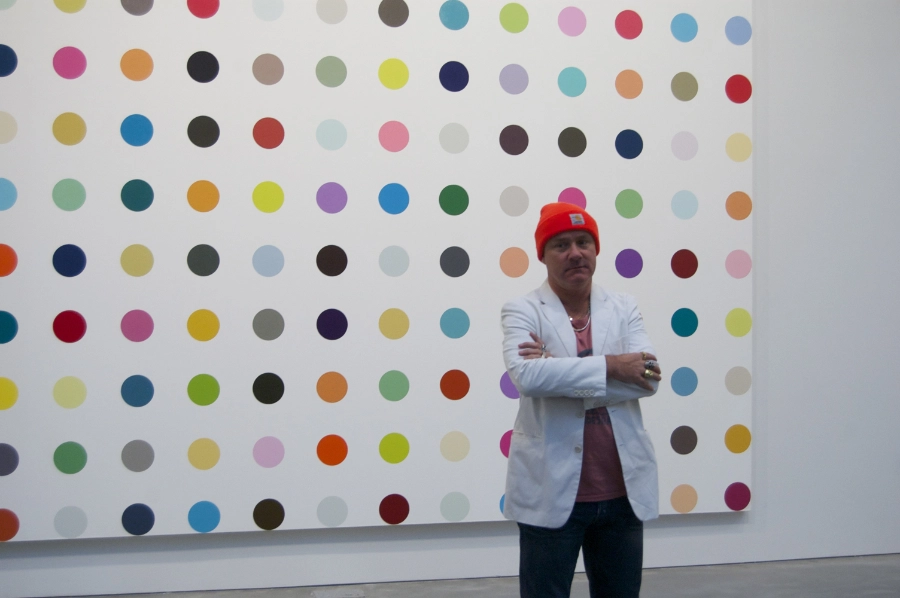
His studio assistants produced much of the series, working from a system that Hirst designed and maintained. When that fact became widely known, not rumored but confirmed, the response from collectors, institutions, and the art market was, essentially, nothing. The works did not lose value. Their critical standing did not shift. What the art world had already decided, and continued to hold, was that the conception, the system, and the decisions were Hirst's. The hand that applied the paint was irrelevant to the question of authorship.
This was not presented as a radical position. It was treated as obvious. Of course, the artist who designs a system and oversees its execution is the author of the resulting work. The alternative, that authorship requires the artist's physical labor at every stage, had already been settled by a half-century of practice that the market and institutions had fully absorbed.
What Hirst demonstrated was not a new argument, but the same argument made visible at scale. Thousands of works, most of them untouched by the named artist, all of them unambiguously his. The separation of conception from execution, taken to its logical conclusion, with no crisis of legitimacy to show for it.
The factory
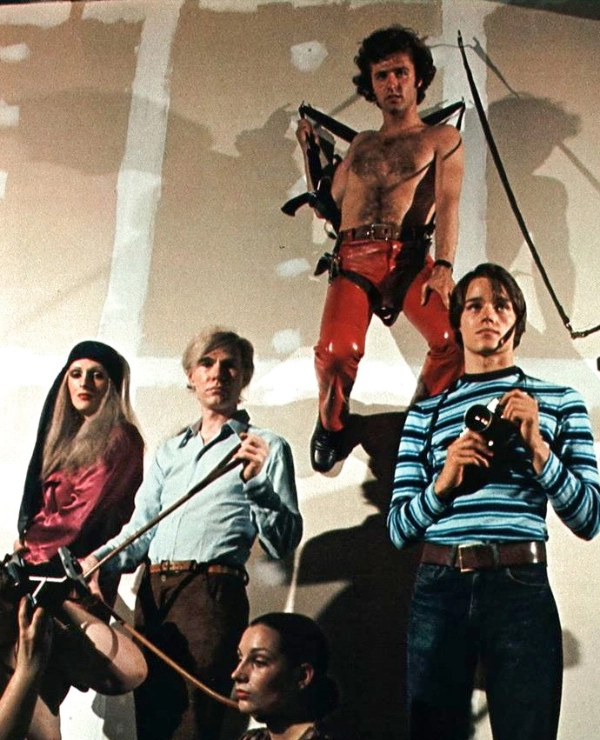
(1969) Claude Picasso
Andy Warhol did not hide the implications of that separation. He named his studio The Factory and ran it accordingly. Works were produced by assistants, sometimes in editions, with Warhol's direct involvement often limited to initial concept and final approval. The silkscreen process he favored was chosen partly because it introduced mechanical repetition and flatness. It deliberately removed the gestural trace that painting had historically used as evidence of authentic authorship.
Collectors paid, and continue to pay, significant sums for that work. Critics wrote extensively about its intelligence. No credible voice in the art world has argued that the Factory model disqualifies Warhol's output as art. What everyone agrees on, regardless of whether they admire it, is that a coherent and recognizable artistic intelligence runs through it. The vision is legible. The choices are accountable to that vision. That has been sufficient.
What it has never been is technically pure, made by a single pair of hands, or answerable to any requirement that the artist must also be the maker.
When the object disappeared
Conceptual art pushed the argument further still. If authorship resided in decision and intention rather than in making, then the physical art object itself was optional. Sol LeWitt's wall drawings were executed by others from written instructions, the instructions themselves constituting the work. Lawrence Weiner issued statements rather than objects. Joseph Kosuth exhibited a chair, a photograph of the chair, and a dictionary definition of "chair" side by side and called the artwork the relationship between them rather than any single element.
The art world's response was not uniform enthusiasm. There was resistance, particularly from collectors and institutions that preferred objects they could hold and sell. But the critical legitimacy of Conceptual art was established, and it was established on terms that were unmistakably clear: what the artist thinks, decides, and frames is the art. Execution is a delivery mechanism.
This is not a marginal position. The artists above are in permanent collections at major institutions. Their work is foundational to how contemporary art is discussed and taught. The argument they made about authorship is now simply assumed in most serious criticism.
The standard photography keeps forgetting
Against that record, the evaluative standard applied to fine art photography becomes very difficult to defend on principled grounds.
The claim that a photograph loses artistic value once the photographer departs from straight capture is not a universal principle of art. Treating compositing, digital construction, or AI assistance as a failure rather than an extension of the work imposes a local rule. That rule is applied inconsistently to photography and sustained by a selective memory of why it was established in the first place.
Hirst's decision to delegate execution entirely is not considered a disqualification. Warhol's decision to introduce mechanical process and remove the artist's hand is not considered a disqualification. LeWitt's decision to reduce the work to a set of written instructions is not considered a disqualification. But a photographer's decision to construct an image rather than capture one is regularly treated as exactly that.
The inconsistency is not accidental. Photography borrowed its cultural authority from its mechanical relationship to the real world, and a significant portion of the audience and market has never fully reconciled that origin with the medium's ambitions as an art form. When photographers behave like artists rather than cameras, some viewers feel that the contract they had with the medium has been revised without their consent.
That is an understandable reaction. It is not an aesthetic criterion.
What the question actually is
The question worth asking of any work of visual art, in any medium, is not how it was made. It is whether a coherent vision is present, whether the work delivers on that vision, and whether the result asks something of the viewer.
Those questions are universal. They are the questions that put Hirst's delegated dot paintings in institutions worldwide and kept thousands of technically accomplished academic works out of them. They are the questions that made Warhol's factory output more critically interesting than much of the hand-made work produced alongside it. They are the questions that Conceptual art argued for so successfully that they are now simply assumed.
They have not been consistently applied to photography and the reason is not hard to find once you stop looking for an aesthetic explanation. The people who set photography's standards built them to serve specific ends: to produce verifiable objects, to protect established markets, to keep the category legible enough to sell. Those are understandable interests. They are not artistic principles.
That distinction is the history worth examining. Not how the medium evolved technically, but how its borders were drawn, what those borders were actually protecting, and who benefited from keeping them in place.
Art Beyond Technique is third in The Post-Photographic Shift series, a reasoned case for vision over method in photographic art.
Acknowledgements
1 Top Banner: Cropped No. 05 Figure Study (2002) | Rick Doble
Candid handheld photograph taken at a slow shutter speed and shot under available light.
CC BY-SA 4.0, via Wikimedia Commons
2 Damien Hirst (2012) | Andrew Russeth
CC BY-SA 2.0, via Wikimedia Commons
3 Cropped: Andy Warhol and the Factory
(1969) Claude Picasso |
Public domain, via Wikimedia Commons