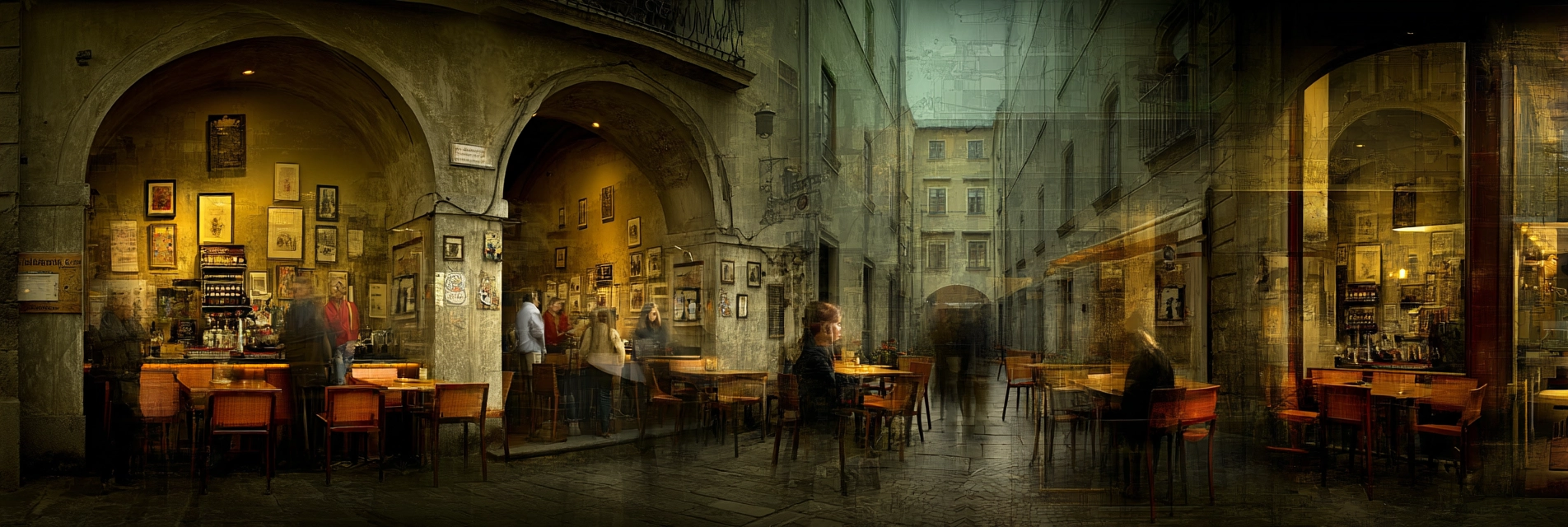
Not "Real" Art? AI and the History of Doubting Machine-Made Images
From early photo manipulation to concrete photography, what yesterday's skepticism can teach us about today's bias against AI‑generated fine art.
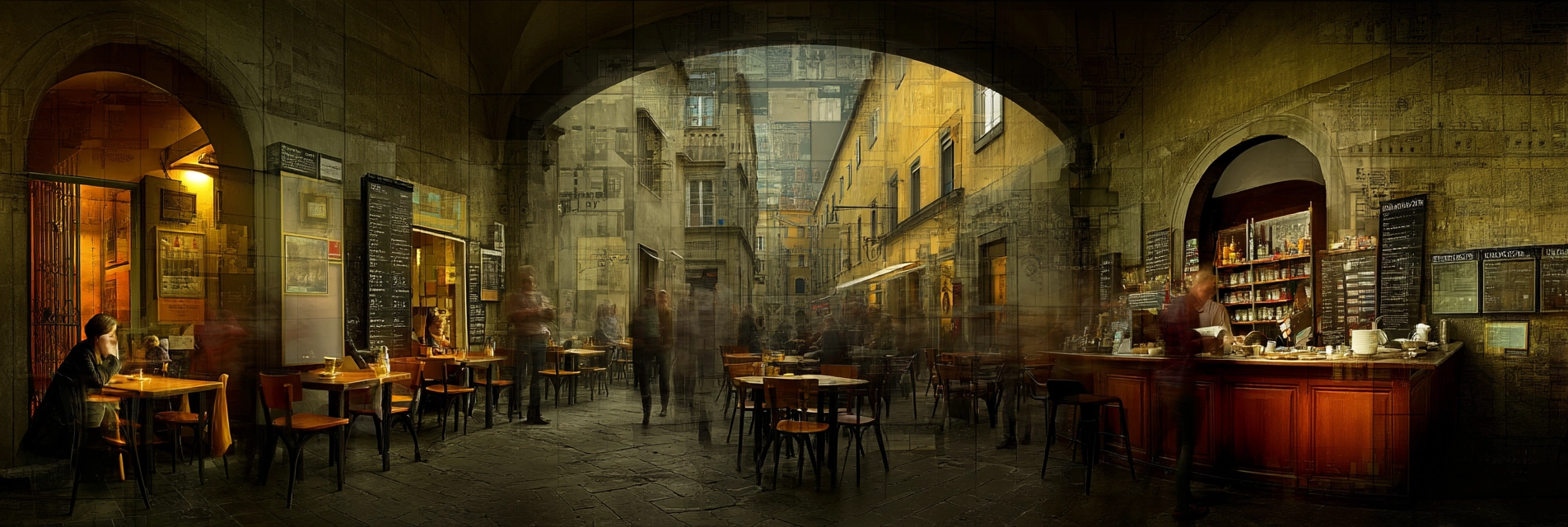
Photography has a legitimacy problem. It always has.
From the moment cameras appeared, critics have argued that images made by machines couldn't really be "real" art. The uproar over AI-generated imagery is just the latest episode of a very old story and understanding that history changes how you see the debate happening right now.
Much of today's bias against AI-generated fine art, especially AI "photography," is repeating patterns the art world has already lived through, more than once. The tools are new. The anxieties are not.
Photography was never "pure"
If you listen to certain gallery statements today, you'd think we just tumbled out of some golden age of photographic innocence into a mess of fake AI pictures. But manipulation has been woven into photography since the very beginning.
Spirit photographers in the 19th century layered negatives and staged elaborate tricks to conjure ghosts for paying clients. Pictorialists at the turn of the century manipulated their prints to resemble the composition of paintings, fighting for photography's place in fine art galleries. Depression-era documentary photographers staged and cropped images to sharpen their political message. Photomontage artists cut and reassembled prints to critique capitalism and war. At every stage, someone was pushing the medium beyond what a straight exposure could deliver and at every stage, the art world eventually caught up.
The uncomfortable truth is this: manipulation isn't an aberration in photography's history. It's been there from the beginning, woven into the ambitions of nearly every movement the medium has produced. Photographs have always been edited, staged, retouched, recombined, and sometimes weaponized. The idea that there was once a pure, untouched photographic truth is a myth that is a comforting story for viewers who want pictures to behave like neutral evidence.
So the argument that AI represents the moment photography became "untrustworthy" starts to look pretty thin. Photography was never a simple mirror. That argument has just been waiting to be made again.
Concrete and generative photography: the artist as architect, not witness
Long before diffusion models and text-to-image tools, artists were already using photography as a generative, rule-based medium. Two key figures here are Gottfried Jäger and Hein Gravenhorst, whose work in "concrete" and "generative" photography offers a surprisingly direct precedent for talking about AI images in a fine art context.
Jäger described concrete photography as creating "objects referring to themselves as independent, authentic, autonomous, autogenic, photographs of photography." These aren't windows onto the world. They're constructions about photography itself. The process is the point. He developed these ideas in dialogue with Concrete Art and Generative Music, aligning photography with mathematical and systematic thinking rather than with representation.
His grid-based works follow predefined rules --- a specific sequence of exposures, a mathematical pattern of light and shadow, a structured permutation of form — and use digital means to execute them. They are photographic in material: light-sensitive surfaces, lenses, darkroom chemistry. But the creative decisions happen before the shutter opens, not during. Jäger isn't responding to the world in front of him. He's constructing the conditions under which an image becomes possible, then letting the process run.
That shift from capturing moments to designing conditions is exactly where AI image-making lives. When an artist curates a dataset, engineers a prompt, selects a model, and shapes the output through iterative refinement, they are doing the same fundamental thing Jäger was doing in the 1970s. The art world didn't just tolerate that approach back then. It celebrated it. Which makes the current refusal to extend the same recognition to AI-generated work much harder to defend on purely artistic grounds.
The machine was always in the studio
The tension around AI isn't about whether machines belong in creative practice. They've been there for a very long time. Cameras, enlargers, scanners, inkjet printers, plotters, software suites are all technical systems that mediate the artist's decisions.
When galleries write about Jäger, they highlight his role as a "photographer of photography" as an artist whose work reflects on the medium using the medium itself. His photographs are "autogenic," generated from internal rules and structures, yet they are treated as serious contributions to photographic discourse. The curatorial language emphasizes autonomy, authenticity, and conceptual rigor. Not the absence of human touch.
That ambivalence toward machine-made art predates AI by decades. It shows up whenever artists use code, robotics, or high degrees of automation. Some collectors embrace it as cutting-edge; a significant portion of the traditional market regards it as a threat to the romantic figure of the solitary author.
So when AI arrived, that old unease was ready to flare up again. Suddenly the "machine" is visible once more. The labor is harder to visualize. The interface consisting of the prompt, the training choices, and the editing pipeline are unfamiliar to audiences trained to value the tripod, the darkroom, or image software presets. But conceptually, AI artists are doing exactly what generative photographers have already done. They make deliberate creative decisions before the image exists. They choose the rules, the inputs, the constraints. Then they shape what emerges.
What discrimination actually looks like
In today's gallery landscape, that unease has hardened into explicit, or quietly implicit, discrimination against AI-generated fine art. It shows up in a few consistent ways.
Open calls issue blanket bans on AI-assisted work, regardless of context or concept. Gallery language dismisses AI art as "not real photography" even when the work draws on photographic training data, camera-based source material, or extensive post-production. Institutions hesitate to represent AI artists, even while hosting exhibitions about "the future of images" or proudly featuring older generative and conceptual photography.
This isn't a neutral quality filter. It's a set of cultural and economic choices and it's necessary to be honest about that.
Jäger's rule-driven grids have a comfortable home in respected galleries. These are images built from mathematical sequences, predetermined exposures, and algorithmic logic. AI-generated work operating on nearly the same creative philosophy often can't get in the door. The difference in how they're treated isn't really about artistic merit. It's about familiarity. One process has an exhibition history, a critical vocabulary, and a comfortable place in the canon. The other doesn't, yet.
At the collector level, the split is equally revealing. Tech-savvy buyers eagerly adopt generative and code-based work while more traditional collectors cling to media where the hand of the maker is visible and the object is rare. AI art often gets shunted into a "tech" category even when it's deeply engaged with photographic history. That framing alone can be enough to close certain doors.
Reframing the conversation
If the goal is productive conversation rather than culture-war standoffs, the frame needs to shift in a few ways.
First, we should stop pretending AI is the singular moment when images became manipulable or untrustworthy. Photography has been staged, retouched, montaged, and manipulated across every era and every movement the medium has produced. That's not a recent development or a digital-age problem. The ethical questions around image truth are real. They're just not new and they didn't start with AI.
Second, this isn't a break from photographic tradition, it's an extension of it. Generative and concrete photographers already proved that photographic art could be systematic, rule-driven, and conceptually rigorous. Jäger turned the camera into a rule machine decades ago, and the art world called it serious. AI image-making takes that same idea into new technical territory. What changes isn't whether the artist is in control it's where that control is exercised. Instead of behind a viewfinder or in a darkroom, it lives in the choices an artist makes about data, prompts, model selection, and post-processing. The hand moves differently. The authorship doesn't disappear.
Third, we can ask a simple, uncomfortable question: why is a rule-based photographic grid from the 1970s canonized while a rule-based AI photographic series today is dismissed as "cheating"? If the answer is really about labor visibility, market stability, or fear of displacement, then we should name those concerns directly instead of hiding them behind claims that AI work is inherently less artistic.
Toward more honest criteria
None of this means galleries must automatically accept every AI-assisted image that crosses their inbox. Standards matter. But if institutions want to maintain credibility, their criteria need to be media-agnostic and concept-forward.
We can ask of AI-generated fine art the same questions we ask of any serious photographic project:
- Does the work have a clear creative intention, and does it deliver on it?
- Does it show awareness of photographic history, including the medium's long tradition of manipulation and construction?
- Can you locate the artist's hand in the choices made, the outputs shaped, the final work assembled?
- Does it ask something of the viewer, or does it simply decorate a wall?
If a body of work answers those questions with depth and clarity, then rejecting it solely because an AI model played a role is less about protecting art and more about policing artificial borders. And in art history, artificial borders have a habit of looking embarrassing in hindsight.
An invitation
So here's the conversation I'd like to invite curators, gallerists, and fellow artists into:
- If we celebrate concrete and generative photography as serious, system-based fine art, what principled reason do we have to exclude AI-generated photographic work that operates with similar rigor?
- If we acknowledge that manipulation has always shaped photography's visual language, why is this particular form of manipulation singled out as illegitimate?
- If we value conceptual authorship over manual execution, can we recognize authorship in the design of an AI-driven image process?
The answers won't be simple, and they shouldn't be. But they should at least be honest about the long history of machine-mediated photography, the role of systems in fine art, and the economic realities that shape institutional choices.
AI didn't suddenly make images artificial. It just made the artificiality harder to ignore.
Resources
Gottfried Jäger: Photographer of Photography
— Exhibition Catalog —
Steven Kasher Gallery, 2016
Photographs and Algorithms
— Estelle Blaschke, Max Bonhomme, Christian
Joschke and Antonio Somaini Transbordeur photographie histoire société
— September 2025
Generative Photography: A Systematic, Constructive Approach
— Gottfried
Jäger — Leonardo, 1986, pp. 19-25
Pinhole Structures. Generative Photographic Works 1967-1974
— Gottfried
Jäger — Pinhole Journal (San Lorenzo, NM), Vol. 5, No. 2, Aug. 1989,
pp. 22-32
Discovering Generative and Concrete Photography in Conversation with
Gunther Dietrich
— Anika Meier — Expanded.art, August 10, 2024
Digital Innovators Reshaping the Art World
— Dan Duray & Farah
Abdessamad — Observer.com
Manufacturing Reality: Photo Manipulation before the Digital Age
— Matthew A. McIntosh — Brewminate.com, January 7, 2026
Key Concrete Photography Artists
Historical Pioneers:
Man Ray ("rayographs"), László Moholy-Nagy, Lucia
Moholy, and Christian Schad ("Schadographs").
Key Practitioners & Theorists:
Gottfried Jäger, Kilian Breier, Pierre
Cordier, and Roger Humbert.
Contemporary Artists
Karl Martin Holzhäuser:
Known for Lichtmalerei (light painting) using,
cameraless, predetermined, and calculated, methods.
Liz Nielsen:
Creates "light paintings" in a color darkroom, using
analog color chemistry and projected gels to create vibrant,
non-representational imagery.
Letha Wilson:
Merges photography with sculpture by incorporating
concrete and steel into her prints.
Alexandra Pospelova:
Explores concrete-to-data themes.
Common Techniques and Concepts
Cameraless Photography:
Creating images directly on light-sensitive
paper.
Structure and Light:
Emphasizing the, physical, and, structural,
properties of the photograph.
Generative Systems:
Using pre-devised rules, or instructions to
determine, the, final, image.
Photograms:
Using objects placed on paper to create shadows and forms.
Special Acknowledgement
A special acknowledgement of Kent Bornemeier's editorial insight and guidance which greatly strengthened this challenging project.