Two Images Know More Than One Boris Mikhailov’s Yesterday’s Sandwich in the Age of Synthetic Images
A single image makes an aggressive offer. It says: this is enough.
That offer is older than generative AI. A photograph can be authentic and still be bad evidence. It can be cropped until a crowd becomes an individual, separated from the minutes before and after it, attached to the wrong date, or circulated beneath a caption that recruits it into an argument it never made. The problem with the convincing image has never been only that it might be fake. The deeper problem is that a surface can look complete while carrying almost no information about the conditions that produced it.
Generative imaging has made that weakness harder to ignore because it has lowered the price of plausibility. We no longer need an elaborate studio, a skilled retoucher, or even a pre-existing event to manufacture a persuasive-looking frame. But the obvious response, becoming better at deciding whether a single image is “real,” is too small for the problem. We need a visual literacy that asks what an image is allowed to prove.
Mikhailov built relation into the image
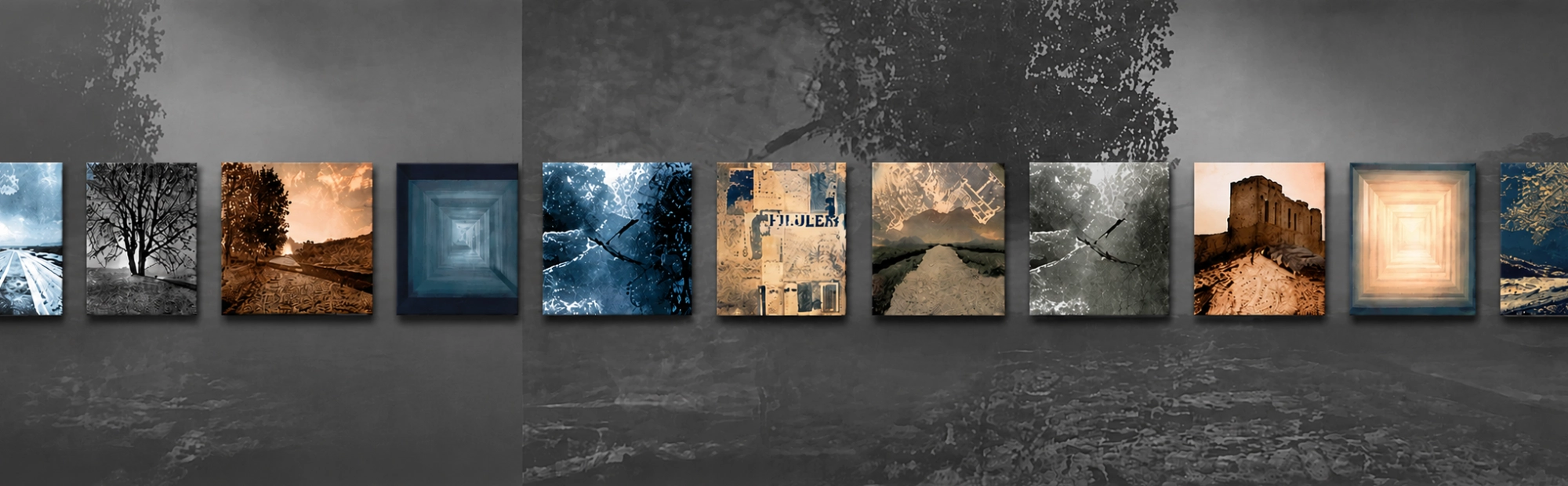
Boris Mikhailov offers an unlikely method for doing that. In Soviet Ukraine in the late 1960s and early 1970s, he developed the body of work later known as Superimpositions, Butterbrot, or Yesterday’s Sandwich. The method began, according to accounts of the series, when two color slides accidentally stuck together. Mikhailov then made the accident deliberate. He overlaid slides and projected them as combinations: private and public, erotic and official, domestic and monumental, one photographic fact interrupting another.
The important thing now is not to turn Yesterday’s Sandwich into an anticipation of Photoshop or generative AI. It was made under different technical and political conditions, and its meanings belong to those conditions. Nor is the point that two images become more truthful simply because they touch. The useful inheritance is structural. Mikhailov built relation into the image. He made the first surface answer to a second one.
That is the move worth carrying forward.
When two photographs collide in Yesterday’s Sandwich, neither is permitted to remain self-sufficient. A body can intrude on a city. A private gesture can contaminate an official scene. Scale becomes unstable. Time becomes ambiguous. Documentary description is forced to coexist with something it did not contain. The result is not an evidentiary verdict. It is an interruption of certainty.
This matters because contemporary image culture keeps moving in the opposite direction. The screenshot, the thumbnail, the reposted still and the viral frame are all optimized for separation. An image is stripped of sequence, source and neighbouring evidence, then asked to carry the weight of an entire event. The more frictionless its circulation becomes, the easier it is to forget that the image once had an outside.
From making to looking
Mikhailov’s making suggests a discipline of looking: if the artist can construct meaning by forcing one image into relation with another, the viewer can refuse to evaluate a consequential image in isolation. This is the hinge between his method and our problem. I am not proposing that viewers imitate his aesthetic. I am proposing that we convert the structure of his making into a habit of seeing.
The first question is therefore not “does this look real?” It is “what would have to exist around this image for its claim to hold?”
Sometimes the answer is another frame. A photograph of a confrontation may change meaning when the preceding seconds become visible. Sometimes it is a wider crop, a different angle, the original caption, the upload history, or a source who can locate the image in time and place. Sometimes it is contradictory material. The point is not to accumulate images until doubt disappears. It is to prevent one persuasive surface from closing the case before the relations around it have been examined.
Adjacency can be faked too
Synthetic imagery makes this more urgent, but it also makes the limits of the method obvious. If one convincing image is cheap to fabricate, two are nearly as cheap. A sequence can be generated. Metadata can be invented. A fake account can manufacture a fake provenance story around a fake photograph. Even technical provenance systems cannot turn the problem into a simple authenticity badge.
That objection should not be treated as a weakness in relational looking. It defines what the method can honestly claim.
The emerging infrastructure for digital provenance is instructive here. The Coalition for Content Provenance and Authenticity has built Content Credentials around cryptographically bound records of an asset’s history: how it was created, what tools were used, and how it was modified. Its own principles are careful: provenance can make assertions verifiable as associated with an asset, but it is not supposed to decide whether the assertions are morally good, substantively true, or sufficient to justify a conclusion. NIST’s work on synthetic-content transparency is similarly plural. Provenance, watermarking, detection, authentication and forensic evaluation are treated as complementary approaches, not as one magic test.
That is exactly the evidentiary lesson. Relation does not prove truth. It raises the burden.
A provenance record gives us something to test against the image. A second frame gives us something to compare. A sequence can expose an edit. A contradictory witness can reopen an apparently settled scene. A content credential can tell us something about the recorded history of a file without telling us whether the event depicted has been interpreted correctly. Each relation adds structure to the claim. None deserves to become a new single surface that we trust without question.
This is where Mikhailov remains useful rather than merely historical. Yesterday’s Sandwich does not give the viewer a cleaner reality behind the first image. It gives us collision. The superimposition produces a third thing that neither slide contained alone, but it also keeps the components visibly unstable. The work does not abolish ambiguity. It organizes it.
The contemporary equivalent should be an evidentiary practice that organizes ambiguity instead of pretending to eliminate it.
Imagine encountering a photograph that appears to show a public figure at a protest. The weak version of visual literacy asks whether the hands look strange, whether the shadows agree, whether a detector assigns a high probability of AI generation. Those checks may be useful, but they keep the image at the centre as a self-contained object. A stronger approach opens the frame outward. Where is the earliest known instance? Is there independent footage from the same place? What happened immediately before and after? Does the claimed date match weather, signage, schedules or other contemporaneous records? What transformations are recorded in the file’s provenance? Do people with independent access to the event disagree about what the image shows?
None of those questions is exotic. Together they change the object under examination. The object is no longer the image. It is the image plus its relations.
The discipline is relational without requiring literal superimposition. Mikhailov could make two slides occupy the same projection because he was making an artwork. A viewer investigating a circulating image has different tools: reverse-image search, archives, neighbouring video frames, geolocation, publication histories, source interviews, signed provenance, even the ordinary act of asking who posted it first. The contemporary “sandwich” may be distributed across tabs, devices and witnesses rather than compressed into one visual field. What matters is that the first image is made answerable to evidence it does not control.
There is also a political advantage to this structure. Calls for visual literacy often collapse into advice to distrust everything, which is useless to anyone who actually has to decide what happened. Generalized suspicion rewards the same actors who benefit from confusion. Relational scrutiny is different. It does not say that nothing can be known. It says knowledge should become more specific as the evidence becomes more connected. The goal is not permanent doubt. The goal is calibrated confidence: claims proportionate to the network of support around them.
This also protects against a mistake that anxiety about generative AI can produce: treating uncredentialed or visually strange media as presumptively false, and credentialed media as presumptively true. Historical photographs, citizen documentation, screenshots, compressed copies and images passed through platforms may have weak or broken provenance for perfectly ordinary reasons. Meanwhile a technically authentic photograph can be used to support a false claim. Evidence does not become trustworthy merely because its chain of custody is elegant.
The standard should therefore be asymmetrical. Missing context should limit what we claim, not automatically tell us the opposite claim is true. A lone image may be enough to say that an image exists. It may be nowhere near enough to establish who made it, when the depicted event occurred, what caused it, or what happened outside the frame.
That is a harder discipline than spotting fakes because it cannot be automated into a reassuring icon. It requires a viewer to tolerate an unfinished conclusion.
Mikhailov’s superimpositions make that unfinishedness visible. They refuse the fantasy that a photograph is a sealed container of meaning. One slide presses on another until each loses the right to stand alone. The visual pleasure of the work comes partly from that collision, but the epistemic value lies in what the collision denies: sufficiency.
The lesson for synthetic-image culture is not “always find two pictures.” It is more demanding. Do not let one picture become an argument merely because it is vivid. Look for sequence. Look for provenance. Look for contradiction. Look for the material outside the crop. Then do the same to the relations you have found.
Two images do not know the truth.
But the second image can force the first to admit that it did not know everything.
Joshua W.J. Brown is a Toronto-based Canadian writer, filmmaker and independent systems researcher. His nonfiction has appeared in Canadian Dimension, Sojourners, Foreign Policy in Focus, Research Information, International Mining and Public Spectrum; his poetry has appeared in The Galway Review. He writes across visual culture, technology, institutions, historical memory and provenance, with particular attention to the point where images, records and technical systems become evidence.
Resources
Boris Mikhailov: Yesterday’s Sandwich | Sprovieri, London | exhibition text, 2018
Boris Mikhailov | Fotomuseum Den Haag | exhibition material, 2024
Photographer Boris Mikhailov’s Ukrainian Diary: ‘He is a kind of proto-punk’ | Sean O’Hagan | The Guardian, 28 August 2022
Guiding Principles for C2PA Designs and Specifications | Coalition for Content Provenance and Authenticity | C2PA
C2PA and Content Credentials Explainer | Coalition for Content Provenance and Authenticity | C2PA Specifications
Content Credentials: C2PA Technical Specification | Coalition for Content Provenance and Authenticity | C2PA Specifications
Reducing Risks Posed by Synthetic Content: An Overview of Technical Approaches to Digital Content Transparency | Bilva Chandra, Jesse Dunietz, Kathleen Roberts, Yooyoung Lee, Peter Fontana and George Awad | NIST AI 100-4, National Institute of Standards and Technology, 2024